You do not need a therapist’s office to start repairing your marriage — with the right structure, couples therapy at home can be just as powerful. The truth is that therapists assign most of the real work as homework anyway — the progress happens at your kitchen table, on your evening walk, and in your bedroom late at night. These marriage counseling exercises at home are drawn from the same evidence-based techniques used in professional couples therapy, adapted so you can practice them tonight with zero special equipment.
Whether your marriage feels distant, argumentative, or simply flat, the couples therapy at home exercises below rebuild the three pillars every strong marriage needs: emotional safety, honest communication, and physical closeness. Work through them slowly, give each one a genuine try, and watch small daily shifts turn into something much bigger.
Why Marriage Counseling Exercises at Home Actually Work
Research into the outcomes of couples therapy is genuinely encouraging. About 70–75% of couples who complete emotionally focused couples therapy move from significant distress to recovery in just 10–12 sessions — and the techniques that drive that recovery are exactly the kind of structured conversations and rituals that make couples therapy at home so effective. The mechanism is simple: relationships change through repeated experiences of turning toward each other, not through one dramatic breakthrough conversation.
Research on remote therapy also shows the format matters far less than consistency: couples who practice structured exercises regularly show improved satisfaction and conflict resolution over time. That is why marriage counseling exercises at home work — your living room becomes the practice field where good habits compound through daily couples therapy at home.
There is one important caveat. DIY exercises are powerful for couples who want to grow closer and resolve ordinary conflict. They are not a replacement for professional help when there is abuse, addiction, untreated mental illness, or deep betrayal involved. We will cover those red flags at the end of this article.
Before You Begin: The Ground Rules for Couples Therapy at Home
Professional therapists do not just hand couples a worksheet and hope for the best. They create conditions that make the exercises work. Set these five ground rules before you start any of the exercises below:
- Pick a regular time. Ten to twenty minutes at the same time each day beats a two-hour marathon once a month. Consistency is the whole game.
- Phones away. Not silenced on the table — in another room. Divided attention quietly tells your partner they are not a priority.
- Listen to understand, not to win. During these exercises, your job is comprehension, not rebuttal. Agree on this explicitly.
- Call a timeout without punishment. If either of you becomes flooded — heart racing, jaw tight, unable to think straight — you can pause for at least 20 minutes and return. This is a researched self-soothing protocol, not stonewalling.
- No scorekeeping. These are team drills, not a competition. If one partner “wins” an exercise, the marriage loses.
10 Marriage Counseling Exercises You Can Do at Home
1. The Daily 10-Minute Check-In
Therapists call this the cornerstone of marriage counseling exercises at home because it prevents small irritations from calcifying into resentment. Every day, spend ten minutes asking each other three questions: What was the best part of your day? What weighed on you today? What is one thing you need from me this week?
Then end with one specific appreciation — not “thanks for everything” but something concrete, like “I noticed you handled bedtime despite being exhausted.” Specificity is what makes appreciation land; couples who do this daily find fights get shorter because nothing festers in silence.
2. The Gratitude Ritual
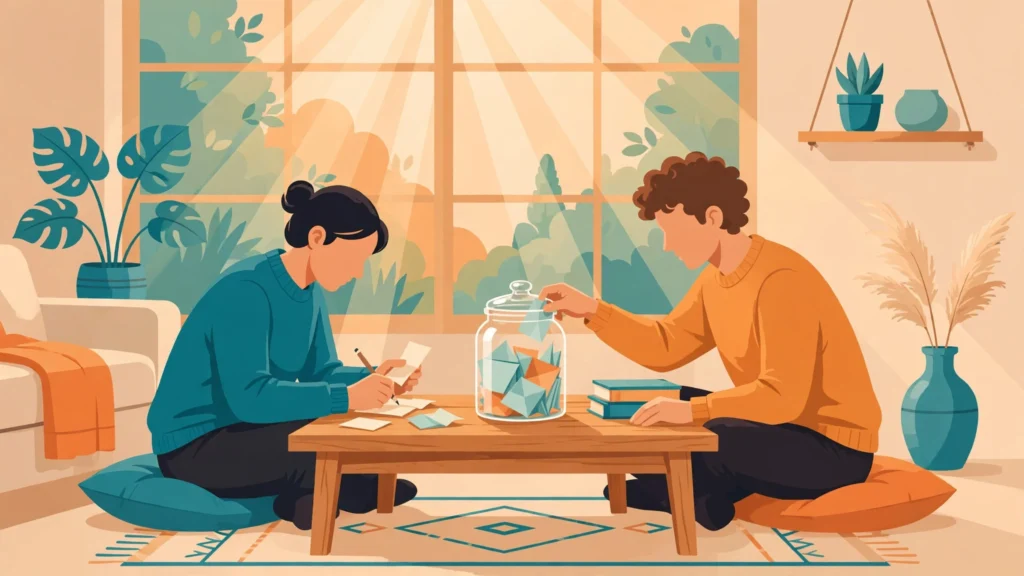
Gratitude sounds soft, but research links it directly to marital happiness and stability. Couples who regularly express appreciation report stronger intimacy and greater resilience during conflict. Keep a jar on your kitchen counter and drop in short notes all week — “You made my coffee exactly how I like it” — then read them aloud together every Sunday.
The ritual works because attention is a spotlight: wherever you point it grows. If writing notes feels forced, try a spoken version at dinner — each partner names one thing they were grateful for that day.
3. Active Listening With Mirroring
Mirroring is one of the simplest marriage counseling exercises at home — and one of the hardest to do well. One partner speaks for three minutes about something meaningful. The other listens without interrupting, then repeats back what they heard in their own words: “So what I’m hearing is that you felt dismissed when I checked my phone during dinner.”
The speaker then confirms or corrects. Only after both partners feel understood do you move to problem-solving. This separation of understanding first, fixing second is the beating heart of couples therapy. Most couples are stunned by how often they were arguing about different things entirely — and mirroring exposes that within minutes.
4. The “I Feel” Statements Swap
Accusations trigger defense; feelings trigger empathy. That is the logic behind this classic therapy technique. Each partner rewrites one recurring complaint as an “I feel” statement using this formula: “I feel [emotion] when [specific behavior] because [underlying need].”
Compare “You never help with the kids” with “I feel overwhelmed when bedtime falls on me three nights in a row because I need to know we are in this together.” Same issue, radically different conversation. Practice by each writing down two complaints, converting them, and reading the new versions aloud. Watch how quickly the room temperature drops — in the best way.
5. The Love Map Update
Dr. John Gottman’s research — one of the most respected bodies of work in relationship science, chronicled by the Gottman Institute — shows that couples in strong marriages maintain detailed “love maps”: rich knowledge of each other’s inner world. People change, and most couples run on outdated maps.
Once a month, ask each other five questions you think you already know the answers to: What is stressing you most right now? What are you secretly proud of? What does a perfect Saturday look like for you these days? What is one dream you have not told me about? Getting answers wrong is the point — each miss is a door into a conversation you have been skipping.
6. The Love Languages Audit
Love-language work is among the most popular marriage counseling exercises at home, and for good reason: many couples love each other fluently but express it in a dialect the other does not register. One partner shows love through acts of service; the other only feels loved through words of affirmation — and both feel unloved.
Take the love languages quiz separately, share your results, then make it concrete: each partner writes down three specific actions in their own love language they would love to receive this week. Not “more quality time” — “a 20-minute walk after dinner with no phones.” Revisit monthly, because love languages can shift with seasons of life.
7. The 20-Second Hug and Physical Affection Reset
Physical touch correlates strongly with relationship satisfaction, and it does something conversation cannot: it calms the nervous system. A hug lasting 20 seconds or more triggers oxytocin release in both partners — the same bonding chemistry that builds trust in therapy sessions.
Build a simple daily minimum: one 20-second hug (set a timer the first few times — it feels longer than you think), one six-second kiss goodbye, and one moment of hand-holding or shoulder contact during the day. It sounds mechanical, but couples consistently report that scheduled affection quickly becomes the most natural part of the day.
8. Honesty Hour Icebreakers
Friendship is the foundation under the romance, and friendship needs curiosity. Once a week, set aside 30 minutes for honesty hour: take turns drawing a question from a jar and answering it with complete honesty. What is your most treasured memory? What would you change about how you were raised? When did you last feel truly proud of me? What scares you about our future?
The famous 36 questions research by psychologist Arthur Aron — published in Personality and Social Psychology Bulletin and popularized by Psychology Today — showed that structured self-disclosure can generate closeness between near-strangers in 45 minutes. Imagine what it does for two people who already love each other.
If honesty hour ever surfaces a stuck pattern — like one partner constantly unable to stop thinking about an ex — treat that as useful data for a calm conversation, not ammunition for a fight.
9. The Repair Conversation Script
This is the exercise most online lists skip, and it may be the most valuable one here. Gottman’s research found that it is not whether couples fight that predicts divorce — it is whether they successfully repair after fighting. Yet almost nobody is taught how to repair. Use this script after any argument, ideally within 24 hours:
- Each partner states their own contribution — not the other’s. “I contributed by raising my voice when I felt cornered.”
- Name the feeling under the anger. Anger is almost always a bodyguard for hurt, fear, or shame. “Underneath, I was scared you had already decided.”
- Ask: “What do you need from me to feel okay again?” Then do that thing, specifically and promptly.
- Close with physical reconnection — a hug, hand on a shoulder, sitting close. The body needs to learn the fight is over.
Couples who practice repair say arguments stop feeling like earthquakes and start feeling like weather — temporary, survivable, and sometimes clearing the air.
10. The Future-Vision Letter
Set a timer for 15 minutes. Each partner writes a letter to the other, dated five years in the future, describing the marriage they hope you are living: where you live, how you spend Sundays, what you have overcome, what you laugh about. Then read them aloud.
This exercise does two powerful things at once. It reminds you that you are on the same team with a shared destination, and it surfaces mismatched expectations — different visions of where you will live, how money works, what retirement looks like — while there is still plenty of time to align them. Seal the letters in an envelope and open them in one year; the annual rereading becomes a tradition of its own.

Your 30-Day Plan: Turning Exercises Into Habits
A list of exercises is not a plan, so here is one. This rotation keeps marriage counseling exercises at home from feeling like homework by mixing quick daily rituals with deeper weekly sessions for sustainable couples therapy at home:
| Week | Daily (10 min) | Weekly session (30–45 min) |
|---|---|---|
| 1 | Daily check-in + 20-second hug | Honesty hour icebreakers |
| 2 | Gratitude ritual + appreciation at dinner | Love map update + love languages audit |
| 3 | “I feel” statements practice on small issues | Active listening with mirroring (one topic each) |
| 4 | Daily check-in + physical affection minimums | Future-vision letters + read week-1 gratitude jar |
After any argument, run the repair script within 24 hours. By day 30 most couples notice fewer blowups, faster recoveries, and a background hum of goodwill. If an old wound keeps resurfacing — say, you are still wondering whether reaching out to an ex is wise — it needs its own dedicated conversation, not more general exercises.
When At-Home Exercises Are Not Enough
None of this means marriage counseling exercises at home failed — it means the situation calls for a professional the way a broken bone calls for a doctor. Seek a licensed couples therapist if any of these are true:
- There is any physical aggression, threats, or controlling behavior. Exercises cannot fix abuse; safety comes first.
- Infidelity has been discovered and the betrayed partner cannot move past it after several months of honest effort.
- One or both partners struggle with addiction or untreated depression or anxiety.
- The same fight repeats weekly with zero progress, or one partner has emotionally checked out entirely.
- Either partner feels unsafe being honest — exercises require vulnerability, and vulnerability requires safety.
Asking for professional help is not admitting defeat. The couples who recover fastest are usually the ones who seek help earliest, while they still like each other enough to fight for the marriage.
FAQs
Do marriage counseling exercises at home really work?
Yes, when both partners participate consistently. These exercises use the same evidence-based techniques taught in professional therapy — active listening, structured check-ins, and repair conversations. Research shows 70–75% of couples in emotionally focused therapy recover from significant distress, and the at-home practice between sessions is where much of that change actually happens.
How often should couples do relationship exercises?
Daily rituals of 10 minutes — a check-in, appreciation, and physical affection — plus one deeper 30–45 minute session per week is the sweet spot most therapists recommend. Consistency matters far more than duration. A 30-day run of small daily practices will change your dynamic more than a single emotional weekend ever could.
Can at-home exercises replace professional marriage counseling?
For couples wanting to grow closer and resolve ordinary conflict, often yes. Think of marriage counseling exercises at home as a complement to professional guidance, not a competitor. If you face abuse, addiction, untreated mental illness, or unresolvable betrayal, professional help is essential — DIY exercises alone will not be enough in those cases.
What if my partner refuses to do the exercises?
Do not lecture or guilt-trip — start with the smallest possible ask. Invite them to just the 20-second hug and one daily appreciation for a week. Many reluctant partners come around once they feel the shift; changing your half of the dynamic often pulls the other in.
How long until we see results from couples exercises at home?
Most couples feel a noticeable warmth within the first two weeks of daily check-ins and appreciation rituals. Deeper patterns — how you fight, how quickly you repair, how safe honesty feels — typically shift over 6 to 12 weeks of steady practice. Track your progress by noticing recovery time after arguments rather than counting the arguments themselves.
What are the best marriage counseling exercises for communication?
The highest-impact trio is active listening with mirroring, “I feel” statement swaps, and the daily check-in. Mirroring guarantees you understand before you respond, “I feel” statements keep complaints from becoming attacks, and the check-in prevents small issues from fermenting into resentment. Master these three and most communication problems shrink dramatically.
Start tonight with the simplest of these marriage counseling exercises at home: a 10-minute check-in, one specific appreciation, and a 20-second hug. It takes less time than scrolling your phones in bed — and it is the first small vote for the marriage you both actually want. Consider it your first night of couples therapy at home. And when you want a lighter moment together, try the site’s free tools — the love calculator and AI relationship assistant are a fun way to keep the curiosity about each other alive.