Remember the early days? The teasing texts that made you grin at your phone mid-meeting. The lingering look across a crowded room. The way you’d invent excuses to brush against each other. That was flirting — effortless and electric. Then came mortgages, meal plans, and school runs, and somewhere in the middle of building a life together, the flirting quietly went extinct. Nobody announced it; it just evaporated, replaced by the efficient, transactional talk of two people running a household. Learning how to flirt with spouse again isn’t about pretending you’re strangers. It’s about reintroducing the playful behaviors — teasing warmth, appreciative glances, charged anticipation — that signal I still see you as desirable, not just dependable.
The good news: flirting is a learnable set of behaviors, and your years together are an unfair advantage — shared history, inside jokes, exact knowledge of what makes your partner blush. Below are 20 concrete ways to use that advantage, the psychology of why they work, and a 30-day system to make playfulness a habit instead of an accident.
Why Flirting Fades in Marriage (And Why It’s Not Your Fault)
Flirting disappears for predictable reasons, not personal failings. First, over-familiarity: flirting thrives on a sliver of delightful uncertainty, and when you can predict your partner’s every move, the brain treats them as a fixture rather than someone to win over. Second, role collapse: when 90% of your interactions are as co-parents and co-managers, the lover identities get buried under logistics — you speak in tasks (“Did you call the plumber?”) instead of attraction. Third, plain depletion: flirting takes surplus energy, and exhausted people default to efficiency. None of this means the spark is dead. It means the conditions that produce spark disappeared — and conditions can be rebuilt, starting this week.
The Science of Flirting in Long-Term Love
Flirting isn’t magic — it’s a learnable cluster of behaviors: humor, open body language, touch, attention, proximity, and eye contact. Underneath, the brain rewards playful uncertainty with dopamine, the chemistry of wanting and anticipation — which is why one well-placed flirty text can give a long-married person a jolt they thought belonged to new love. The chemistry never left; the behaviors that trigger it just stopped.
There’s a relational layer too. Dr. John Gottman’s research found that thriving couples constantly make small bids for connection — invitations to engage and play. Flirting is one of the purest bids: come play with me, I find you delightful. When your partner “turns toward” it, you both get a micro-hit of connection; when bids stop, the relationship goes gray. The Gottman Institute has documented this dynamic for decades — and it’s the scientific backbone of knowing how to flirt with spouse effectively rather than randomly.
How to Flirt With Spouse: The Verbal Moves
Words are the most accessible flirting channel. Use your shared history — no stranger can compete with it.
1. Tease with warmth, never with a barb. “You’re trouble, you know that?” said with a grin is flirting; sarcasm with an edge is not. The test: does it make them feel desired, or small?
2. Give a charged compliment — specific, not generic. “You look nice” is polite. “That shirt is doing something for me” is flirting. Long-term partners are starved of being looked at this way.
3. Bring back the flirty text. A single “thinking about you, and not in a wholesome way” mid-afternoon does more for the evening than any logistics. Texting builds anticipation across the workday on purpose.
4. Recall your shared history. “Remember that night in Lisbon?” pulls you both into a charged memory and signals I still think about us that way. Most couples never draw from this well.
5. Ask them out — actually ask. There’s something thrilling about being asked on a date, even by someone you see daily. Send a proper invitation text. You’ll both have something to look forward to.
How to Flirt With Spouse: The Non-Verbal Moves
Non-verbal flirting often lands harder than words, because it bypasses the logistical brain entirely.
6. Eye contact that lingers a beat too long. Busy couples talk while facing the dishwasher. Holding your partner’s gaze one extra moment, with a small smile, measurably raises arousal and connection.
7. Touch with no agenda. In many marriages, all touch becomes functional or a direct proposition. Reintroduce the flirty middle — the hand on the lower back, the squeeze of the knee under the table that means I’m into you and nothing more.
8. The slow goodbye and hello. A kiss that lasts a beat longer than necessary, a real embrace at the door. Gottman’s research recommends a six-second kiss for exactly this reason.
9. Open body language and proximity. Turn toward your partner. Stand closer than logistics require. Catch their eye across a crowded room — that “I’d choose you again” glance is flirting in its purest form.
10. Steal kisses and play footsie. A kiss at a red light, feet brushing under a restaurant table. Subverting expectations is half of what flirting is.

Daily Rituals and Surprises That Keep It Playful
Grand gestures are rare; rituals are daily. This is where learning how to flirt with spouse pays off long-term.
11. Leave a love note where they’ll find it. Mirror, dashboard, lunchbox, pillow. “You still make my heart race” costs nothing and works all day.
12. Dance in the kitchen. Put on a song while dinner simmers and pull your spouse into a twirl. Nobody’s watching, which makes it safe to be silly.
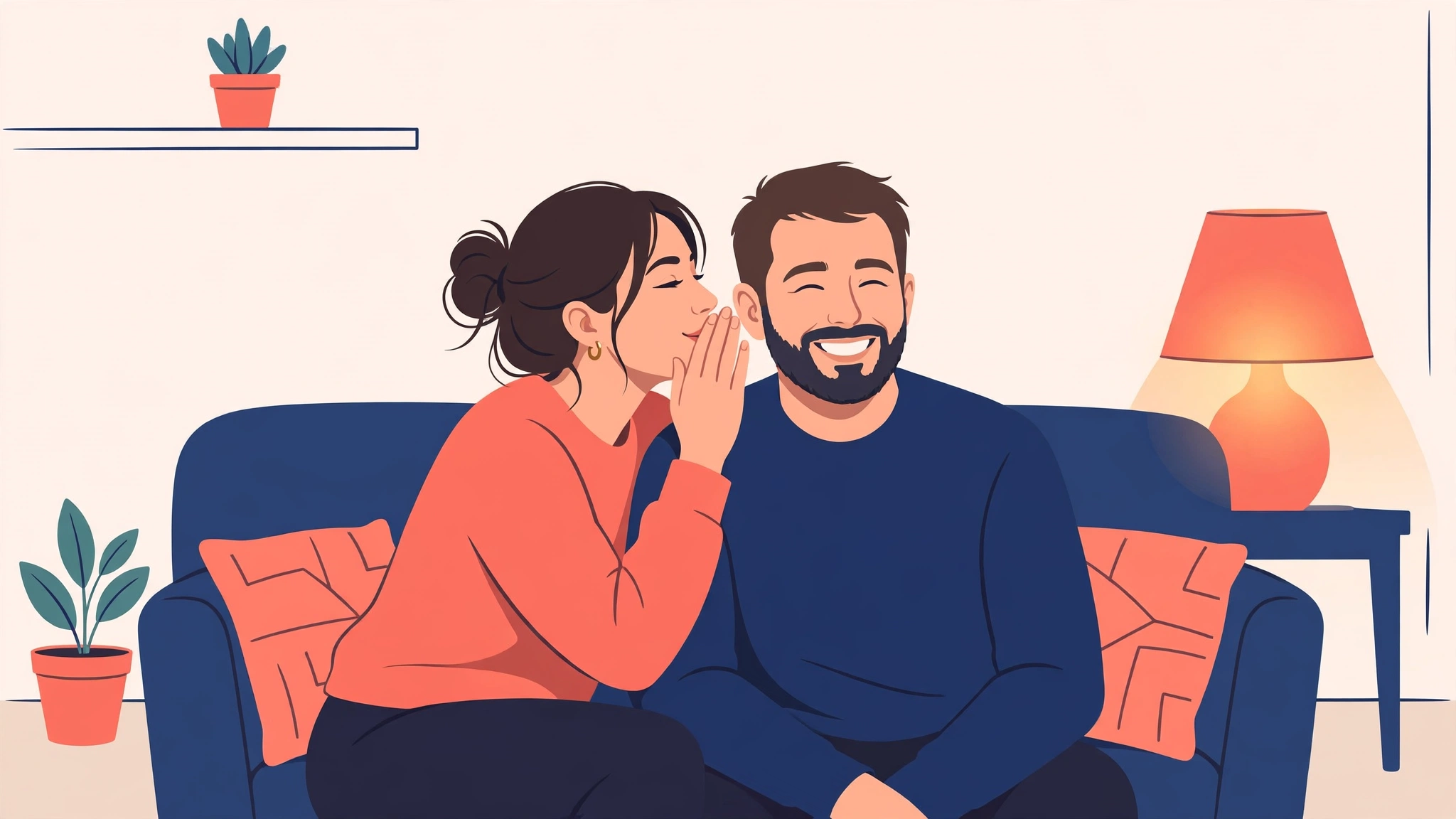
13. Whisper something playful in their ear. At a party, in the grocery aisle — “You look dangerously good tonight” is electric precisely because it’s private in public.
14. Brag about them in front of others. “She’s the funniest person I know” hits differently than a private compliment. It tells the room you’re proud you chose them.
15. Schedule desire, then tease it. Put a date night on the calendar, then build anticipation with texts all day. Planned doesn’t mean unsexy — knowing something’s coming creates a forward charge spontaneity rarely sustains.
Flirting Around the Kids and on Low Energy
16. The secret signal. Invent a gesture only you two understand — a code word, a specific wink — and use it at family gatherings. Shared secrecy is flirting’s native habitat.
17. Micro-flirts for exhausted days. One lingering look, one specific compliment, one six-second kiss. Small compounds — three micro-flirts a day out-flirt a perfect date night that never happens.
18. The five-minute pillow-talk window. Phones down before sleep; five minutes of non-logistical talk. Protect this tiny window and it becomes the most flirtatious part of your day.
19. The morning send-off. Walk them to the door, fix their collar, say one charged thing: “Come home to me.” A daily transition becomes a daily flirt.
20. The reunion reset. Fence off the first ten minutes after you’re back together each evening — no logistics. Greet like you missed them, because you did.
The Flirt-Rejection Fear Protocol: Restarting When It Feels Risky
Here’s what list-style guides never address: what if you try and it lands flat? One awkward attempt can silence someone for months. The fix is a micro-bid ladder — start so small it can’t fail, read the response, then escalate. This is the missing manual for how to flirt with spouse when confidence is low.
Rung 1 — Zero-risk bids: a lingering smile, one extra second of eye contact, standing slightly closer. Barely bids at all. Do three a day for a week.
Rung 2 — Low-risk bids: one specific compliment, a hand on the back as you pass, a “thinking of you” text with no agenda. If these earn a smile or a returned touch, you’re cleared for rung 3.
Rung 3 — Playful-risk bids: the teasing line, the charged compliment, the whispered comment in public. By now you’ve banked a week of positive micro-moments, so one miss won’t register as rejection.
If a bid lands awkwardly, don’t freeze. Laugh: “Well, that sounded smoother in my head.” Humor repairs flirt-fails instantly — and the willingness to be a little ridiculous is the flirt. Couples who flirt well aren’t the ones who never miss; they’re the ones who recover in three seconds.
Flirt in Your Spouse’s Love Language, Not Yours
The biggest reason well-meant flirting falls flat: you’re flirting in your channel, not theirs. A words-of-affirmation spouse melts at a charged compliment; an acts-of-service spouse barely registers it — but making their coffee exactly right, delivered with a lingering look and “I take care of what’s mine,” lands like a thunderbolt. Calibrating to their receptivity is advanced-level skill in how to flirt with spouse, and it’s what separates effort from impact.
- Words of affirmation: charged compliments, flirty texts, whispered lines, bragging about them.
- Physical touch: agenda-free touch, lingering kisses, footsie, the slow goodbye.
- Quality time: the protected reunion window, kitchen dancing, pillow-talk minutes.
- Acts of service: surprise favors framed flirtatiously — “Handled it, because I’d rather spend the evening looking at you.”
- Receiving gifts: the unexpected small gift with a charged note attached.
This matters doubly when desire levels differ. If your spouse is the lower-desire partner, overtly sexual flirting can feel like pressure. Flirt instead in channels that say you’re adored and safe — warmth, admiration, gentle touch — and let escalation follow their lead. Flirting that respects a partner’s pace builds more desire over time than flirting that pushes past it. Psychology Today covers the desire-gap dynamic extensively, and the research consistently favors patience.
The 30-Day Playfulness Habit (Plus Your Weekly Spark Check)
Moves are useless without a system. Flirting dies when treated as a mood; it survives as a habit.
The daily minimum: three micro-flirts a day — one verbal, one non-verbal, one in your spouse’s love language. Set a phone reminder for the first two weeks. Doing it on purpose doesn’t make it fake; it makes it reliable.
The weekly spark check: once a week, each of you scores 1–10 on “How chosen and desired did I feel this week?” Share numbers without defensiveness — a 4 is data, not an accusation. Then each names one flirtatious thing the other did that worked. This makes effort visible (unnoticed effort stops) and teaches you exactly which moves land on your spouse.
The monthly adventure: once a month, do one thing slightly outside routine — a new restaurant, a drive with no destination. Shared novelty spikes the same dopamine flirting runs on.
One honest note: if your texts have become pure logistics, name it. Married couples can drift into a version of the pattern dating coaches call breadcrumbing — just enough contact to maintain the connection, never enough to feed it. Flirting is the deliberate opposite: attention with intent. And if you’re restarting after a genuinely rough patch — betrayal, a separation scare — repair comes first; playfulness needs a floor of safety. If your situation involved considering the end, our guide on how to break up nicely clarifies what real repair requires before flirting can feel safe.
FAQs
Is it normal to stop flirting after marriage?
Completely normal — and reversible. Research shows flirting fades from over-familiarity, role collapse into co-parent identities, and exhaustion, not from lost attraction. The spark doesn’t die; the behaviors producing it just stop. Couples who deliberately reintroduce playful bids for connection typically report feeling desired again within weeks of consistent effort.
How do I flirt with my spouse when we’re always busy?
Go microscopic. Three micro-flirts a day — a lingering look, one specific compliment, a six-second kiss — take under a minute and beat a monthly grand gesture. Protect the first ten minutes after you reunite each evening as a logistics-free zone. Busy couples need protected moments, not more time.
What if my spouse doesn’t respond to my flirting?
First, check the channel: you may be flirting in your love language instead of theirs — try touch if words aren’t landing. Second, use the micro-bid ladder: drop to zero-risk bids for a week before escalating. Consistently zero response over weeks means a conversation about disconnection, not a technique problem.
How do I flirt without creating pressure for sex?
Reintroduce agenda-free touch and verbal play that asks for nothing — the hand on the back, the whispered compliment, the lingering look. Say so explicitly at first: “Just wanted you to know I think you’re gorgeous — no agenda.” When touch stops being a yes-or-no question about sex, it becomes flirtation again, and desire often follows.
How can we flirt with kids around?
Invent a secret signal only you two understand — a code word, a specific wink — and use it freely in front of the children. Keep verbal flirts warm rather than explicit when little ears are near, save the charged material for private moments, and remember that kids seeing parents playful is genuinely good for them.
How long does it take to bring the spark back?
Most couples notice a shift within two to three weeks of consistent daily micro-flirts — you’re rebuilding a habit, not waiting for a feeling. The weekly spark check accelerates this by making effort visible. Deeper patterns like desire gaps or unresolved hurt take longer; flirting is the daily practice, not the whole cure.
Flirting with your spouse isn’t about recapturing who you were at twenty-five — it’s about choosing each other, playfully and on purpose, at the stage you’re in now. Start tonight: one lingering look, one specific compliment, one kiss that lasts a beat too long. Small compounds. And if you want a fun way to stay curious about what makes your particular love tick, try the free love calculator and the AI relationship assistant at relationshiptips.net — the couples who stay playful are the ones who stay curious about each other.