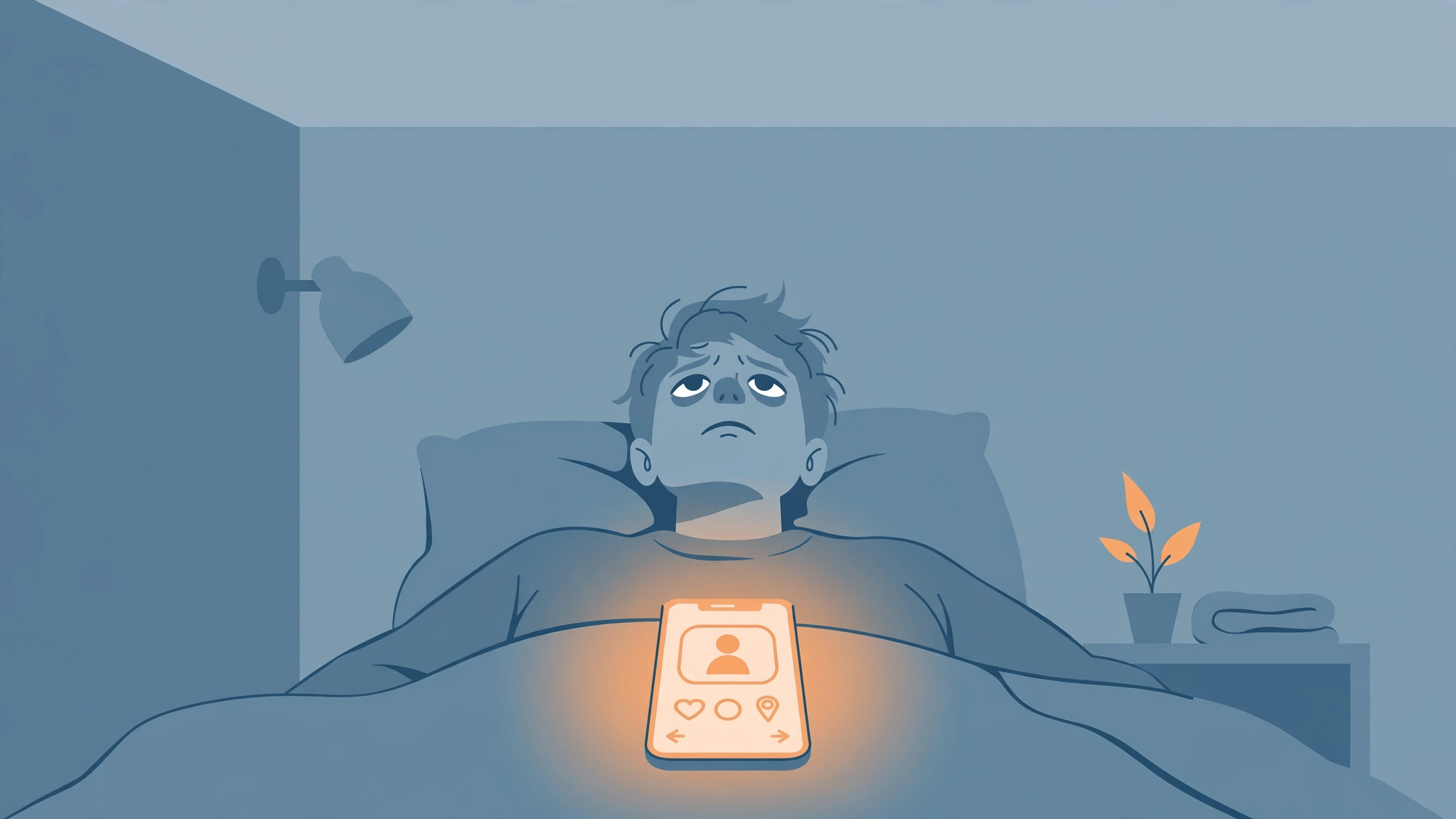
If a text from an interesting match now feels like homework instead of a thrill, you may simply be burned out. The clearest dating burnout signs creep in slowly: a little dread before each date, a little less curiosity with each match, a little more cynicism with each ghosting. Below are the nine most common dating burnout signs, and how to recover from them.
What Dating Burnout Actually Is
Burnout is a word we usually reserve for jobs, but the mechanics are identical in romance: sustained effort keeps failing to pay off, and the effort starts costing more than you have. In dating, that effort is emotional as much as practical — presenting your best self, staying hopeful, reading signals, absorbing small rejections, then doing it all again next week. The earliest dating burnout signs appear exactly here, where cost starts exceeding reward.
This is not the same as a bad week. A bad week passes when something good happens; burnout does not, because the good thing itself starts to feel like another task. Surveys find nearly 8 in 10 adults aged 18 to 54 have experienced online dating burnout — and most say they wished they had taken a break sooner.
9 Dating Burnout Signs You Should Not Ignore
The dating burnout signs below rarely arrive all at once — most people notice one or two, dismiss them, and only see the pattern later. For a personal score, take the self-check in the next section.
1. A date makes your stomach sink
A healthy dating life comes with butterflies, or at least mild excitement. One of the earliest dating burnout signs is dread: a message suggesting drinks on Friday, and your first feeling is heaviness. If you catch yourself hoping they cancel, pay attention — hoping for a cancellation means the cost has overtaken the reward.
2. You feel numb, not curious
You match with lovely people who write thoughtful messages, and you feel nothing — not even curiosity. Burned-out daters say “everyone looks the same,” which is rarely about the people and almost always about the person looking. When curiosity dies, your battery is empty.
3. Dating has become a chore
Monday: swiping. Wednesday: messaging. Saturday: the date. When your love life runs on a schedule you resent, dating has crossed from adventure to obligation. If you must talk yourself into replying like you talk yourself into laundry, that is one of the classic dating burnout signs.
4. You narrate every date before it happens
“He’ll say he’s not looking for anything serious.” “She’ll disappear after Tuesday.” A little realism is healthy, but automatic expectation of disappointment is a defense that keeps everyone out. Cynicism protects you from hope — and sabotages the connections you want.
5. You check out mid-date
You check the time and give short answers because you have told the same stories fifteen times. You are not unkind, but you are not there — and the person across the table feels it. If anyone has said you “seemed somewhere else,” that is burnout in your body language.
6. The delete-and-redownload loop
Rage-deleting the apps on Sunday and reinstalling Wednesday is not decisiveness — it is exhaustion looking for an exit it never takes. If your phone is a revolving door of dating apps, you are not taking breaks. You are flinching.
7. Rejection hits ten times harder
A match going quiet used to sting; now it ruins your evening. When you are burned out, every small rejection lands on an already-bruised spot, and “this always happens to me” starts sounding like fact instead of feeling.
8. Your self-esteem is eroding
You second-guess your photos, your jokes, your personality. You may shrink your standards — or raise them impossibly high so you have an excuse not to try. Both are dating burnout signs in different disguises.
9. It leaks into the rest of your life
You are snappy with friends who ask how dating is going, and flat about things unrelated to romance. When burnout spreads beyond dating, your whole system is telling you loudly: it is time to stop.
Take the 60-Second Dating Burnout Self-Check
Most guides list dating burnout signs and leave you guessing. This scored check tells you exactly where you stand — answer yes or no:
- Do you feel dread — not excitement — when someone suggests a date?
- Have you caught yourself hoping a date would cancel?
- Do new matches spark little or no curiosity?
- Do you describe dating as “exhausting” more than “fun”?
- Have you deleted and reinstalled a dating app this month?
- Do you expect dates to disappoint before they happen?
- Do you go through the motions on dates?
- Does rejection upset you far more than six months ago?
- Is dating draining your friendships, work, or hobbies too?
- 0–2 yeses: Tired, not burned out — adjust your approach with the fixes below.
- 3–5 yeses: Yellow zone — take a deliberate two-to-four-week pause.
- 6–9 yeses: Burned out — take a real six-to-eight-week break with a defined end date.
Why Dating Feels So Exhausting Right Now
Understanding the machinery stops the self-blame. Psychologists describe dating as a poor effort-to-reward ratio: dozens of matches, a handful of conversations, a few dates, maybe one second date. Your brain learns that effort does not reliably pay off — and quietly withdraws the energy it will spend.
Then decision fatigue sets in. Every swipe is a tiny judgment call on a limited supply of attention. After forty profiles on a Wednesday night, you have little left for the one person you might actually like. More options do not satisfy us; they deplete us.
Finally, micro-rejections accumulate: the match who goes silent, the date who never follows up. None is dramatic alone, but they pile up — and you carry them into the next date more guarded, less warm, and more likely to produce the very flatness you fear.
Understanding these dating burnout signs is the first step to reversing them — burnout is a state, not a personality trait.
The Early-Warning Yellow Lights (Catch It Before It Spreads)
Most articles about dating burnout signs only describe full burnout. Prevention is easier — watch for these yellow lights, which surface weeks before the red flags:
- You batch dating like admin work (“I’ll clear my message inbox on Sunday”).
- Explaining a date to friends feels like more effort than the date itself.
- You screenshot profiles to mock them instead of engaging with them.
- You feel relief, not disappointment, when a promising conversation fizzles.
- You are dating on autopilot — same stories, same jokes, same café — with zero sense of play.
Spot two or more? You do not need a three-month hibernation — just active recovery: halve your dating volume, swap one app session for an in-person event, and cap yourself at one date per week for a month. Small corrections now prevent a full crash later.
How to Take a Break That Actually Works
A break spent refreshing the app “just to look” is not a break — it is overtime from home. Make yours count:
Give it edges
Decide the length before you start: four to eight weeks suits most people. Put the end date in your calendar, because an open-ended break has a way of becoming a year.
Be clear about what you are stopping
For most people it is the apps, the messaging, and the dating itself. For some it is also the constant analysis: the group-chat debriefs, the attachment-style podcasts, the hours decoding his silence. Stopping the apps while researching dating three hours a night is not rest.
Tell one or two people
Not for permission — accountability makes the break easier to hold. When someone says “you should try this new app,” you can simply reply “I’m on a dating break until next month.” An accountability buddy turns a private intention into a real commitment.
Do not turn the break into a project
Resist the self-improvement sprint. The point is to refill the tank, not rebuild the car: see neglected friends, revisit a hobby with no audience, sleep more. The surest sign it is working: you stop thinking about dating for whole afternoons.
Catching dating burnout signs early means a shorter break will do the job; the longer you wait, the longer the recovery takes.
How to Pause Without Burning Bridges
One reason people avoid breaks is guilt: what about the conversations going well? Here is the logistics part nobody talks about.
If you are mid-conversation with someone promising, do not ghost. Send one honest message first: “Hey, I’ve really enjoyed chatting, but I’m taking a proper break from dating for the next month to recharge. I’d love to pick this up when I’m back if you’re still around — no pressure either way.”
Pause, do not just delete. Most apps let you pause your profile so you vanish from the stack without losing matches. If the app’s presence tempts you to “just check,” delete it — but note the one or two connections worth revisiting first.
Handle social pressure in advance. Decide your line now: “Thanks, but I’m off the circuit until December — I’ll let you know when I’m back.” Saying it once beats the same conversation six times. For more on handling awkward dating conversations with grace, see our guide on how to break up with someone nicely.
Your Week-by-Week Comeback Plan
Burnout recurs when people return to the same pattern at the same intensity and ignore the dating burnout signs that warned them the first time. This eight-week sequence rebuilds your energy gradually instead of all at once.
- Weeks 1–2: Full digital detox. Apps paused, notifications off, no “just checking.” Fill the hours with sleep, movement, and people who already love you.
- Weeks 3–4: Reconnect with yourself. Write down your top five relationship needs and three to five genuine dealbreakers — the intentional-dating compass clinical psychologists recommend.
- Weeks 5–6: Rebuild social energy. Say yes to group plans, try one new activity, be a person in the world again rather than a profile.
- Week 7: The readiness check. Does a first date spark even a flicker of curiosity? If yes, you are ready. If it still feels like homework, extend two weeks — no guilt.
- Week 8: Soft relaunch. One app, not three. Twenty minutes a day. Two dates per week max. Suggest meeting within the first several messages — less limbo, less drain, better dates.

How to Come Back Stronger
Returning well is a skill with rules. Start smaller than feels necessary: one app, a time cap, fewer conversations than you think you can handle. A date you are only moderately interested in costs the same energy as one you are excited about — spend it on the second kind.
Be upfront early. State what you are looking for within the first few messages; authenticity weeds out mismatches fast. If old patterns creep back (2 a.m. swiping, six simultaneous conversations), treat it as a yellow light and correct course.
Build in recovery between dates. After a date that goes nowhere, give yourself a day instead of scheduling another immediately. The people who stay in the game longest are not the ones who never tire — they are the ones who learned to rest. And spotting breadcrumbing early saves weeks of slow-drain conversations.
If any dating burnout signs creep back, treat them as yellow lights: scale back to one app and one date a week before full exhaustion returns.
When a Break Is Not Enough
Sometimes the flatness stays well after the break. If you are low in a way that is not just about dating — poor sleep, lost interest in things you enjoy, hopelessness most days — consider speaking with a counselor. Burnout can sit alongside anxiety or depression, and it is easier to untangle with support. When dating burnout signs persist long after rest, that persistence is information, not failure — and a sign you may benefit from professional support.
As clinical psychologist Dr. Roxy Zarrabi writes on Psychology Today, dating requires openness and vulnerability — and when burnout depletes that capacity, a therapist or relationship coach can help you rebuild it. There is no shame in asking, and no need to wait until it feels “bad enough.” An in-depth look at the break-and-return process from Wisp’s dating research team agrees: rest first, but get support if the heaviness lingers.
FAQs
How long should I take a break from dating?
Most experts suggest four to eight weeks — long enough for your nervous system to settle, short enough that dating does not become something you abandoned. Set an end date in advance; if you reach it still drained, extend two weeks rather than forcing a return.
Is dating burnout real, or am I just being picky?
It is real, and it is common — nearly 8 in 10 adults aged 18 to 54 report experiencing it. Being picky means knowing what you want and holding out for it. Burnout means feeling dread, numbness, or cynicism about the process itself, even toward people you would normally find appealing.
Will I miss “the one” while I am on a break?
Almost certainly not. The right person is not a limited-time offer, and meeting them while you are burned out usually backfires anyway — you will be too depleted to show up well. Many people report meeting their long-term partner shortly after a deliberate break, precisely because they returned with energy and clarity.
Should I delete my dating apps or just pause them?
Pausing is usually smarter: you vanish from the stack without losing matches and conversations. Delete only if the app’s presence on your phone tempts you to “just check.” Either way, send a brief honest message to any promising conversations before you go quiet — ghosting mid-break creates guilt that ruins the rest.
How do I know when I am ready to date again?
Try the curiosity test: does the idea of a first date spark even a flicker of interest, rather than dread? Can you imagine enjoying the conversation regardless of the outcome? If yes, start slow — one app, a time cap, two dates a week maximum. If the thought still feels like homework, give it two more weeks.
What should I do instead of dating during my break?
Anything that makes you feel like a person rather than a profile: neglected friendships, hobbies with no audience, exercise, sleep, a weekend trip with zero dating potential. Resist turning the break into a self-improvement project — the goal is refilling your tank, not rebuilding the car.
Taking a break from dating is not giving up on love — it is protecting your ability to recognize it when it arrives. If this guide helped you spot your own dating burnout signs, try our free tools at relationshiptips.net — the love calculator for a little fun, or our AI relationship assistant for judgment-free dating advice. Bookmark this guide — revisiting these dating burnout signs once a month keeps you ahead of the next dip. Come back when you are ready. The right person will still be there.