There are various theories on the reasons why relationships end; however, many agree that poor communication is a major factor in many relationships. I have seen couples love one another deeply, yet couples often run into problems when couples cannot clearly express what couples need. Then couples cannot listen well. Couples do not take deliberate steps to fix problems when they appear.
In the context of relationships, the ability of couples to clearly say what couples feel and what couples expect while couples are careful and in how couples speak is what matters most.
The barriers to real communication usually manifest themselves when couples are either afraid to be confronted or when they are unable to be so. It is in the absence of such communication that problems are compounded.
Good communication keeps the emotional distance between partners really short, but lack of it lets resentment build up. The goal of good communication is to avoid the need to guess what another person means.
The value of communication in a relationship
It is easy to see how the absence of communication leads to a breakdown of a relationship—bitterness and passive-aggressive behavior can compound the smallest of misunderstandings.
Improving communication in a relationship can bring challenges. Yet when couples work on communication, they can grow closer. They can also better understand each other’s needs. They can express their needs more clearly. They can learn how to set and keep healthy boundaries.
9 Ways to Communicate Better in a Relationship
1. Listen to understand before you speak
Listening is definitely one of the ignored parts of talking to someone. Do your best to really understand what your partner is trying to communicate when they are sharing something with you. Thinking quickly about a response or getting upset usually makes one person feel like their words are not important.
Paying real, active attention while also being able to pose relevant questions or address the feelings, even to an extent you don’t agree, tends to do more to bridge the gap and make problems less frustrating.
2. Be direct
It isn’t fair to expect your significant other to read your mind. “I felt ignored when we didn’t talk about our plans” provides actual fodder for a response, whereas frustration just stays general and vague, as frustration tends to do.
Using “I feel,” “I need,” and “I wish” phrases tend to diffuse conflict less harshly.
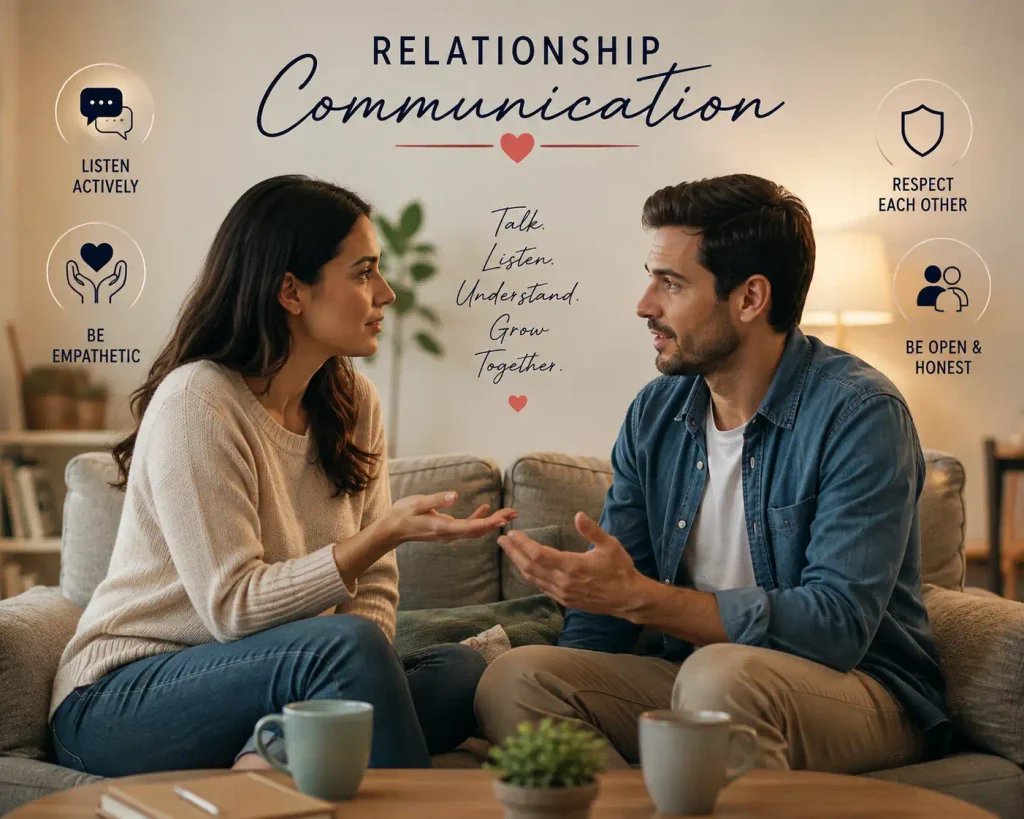
3. Don’t Treat Every Situation as a Fight
Not all situations need to be resolved by a winnerless, angry, unwilling-to-understand debate. If you get overly passionate about something, just leaving the situation tends to help. However, it is needed to return to the problem and talk out the solution. Aim to understand instead of winning.
4. Be honest. Don’t hurt.
Honesty doesn’t require words.
- You can say the truth without cutting deep.
- Choose your words carefully.
- Make sure they are kind even when they are true.
- Your partner should feel respected, not attacked.
- Even when you need to speak, things stay gentle.
- Truth and kindness can go together.
- It’s possible to be real and still care.
- Be honest, without being cruel.
Good communication means your partner leaves with more understanding, not a wound. For more on this, see what healthy relationships have in common.
5. Choose The Right Time To Speak
Sometimes there is no good time, but waiting to have a serious conversation until your partner is resting isn’t the bad time. When you approach them at that time, start with the question, “Is this a good time to speak about _______?”
6. Observe How Your Partner Conveys Himself
People don’t always do things the same way. Not everyone is going to need to speak. Some people need to think about what they’re going to say first. Some people will want to talk without writing anything down. Others will need to write things down to get their thoughts clear before they speak.
The point isn’t to make someone see things, like you do. It’s to find a way to talk that works well for both of you.
7. Discuss Expectations
One of the most common causes of relationship issues is failing to discuss expectations. Couples should be more open about the following:
- Preferred time together
- Preferred Space and Boundaries
- Cash and balance
- Obligated plans
- Future aspirations
- Relations with family and friends
- Providing Support
- Style for conflict resolution
You must continue this convo, as time will change your expectations.
8. Don’t Misuse Silence
There’s a difference between losing your temper and going for the silent treatment. Taking no action on communication, with no reason, makes your partner feel anxious, confused, and rejected.
If you need some space, make a statement like, ‘I need some time to think; I’ll get back to you on this.’ A short pause can help. Shutting someone out will only escalate your issue.
9. Learn to heal from conflict.
Disagreements happen in relationships, and even though they are not good, they do happen. The important thing is what happens after the disagreement.
An apology, following discussions, and a small, thoughtful deed can help resolve the issues.
It’s best to view new arguments and disagreements as learning opportunities, rather than using previous arguments as a reason to lose your temper again. Focus on moving to avoid problems in the future.
Communication and healthy boundaries
Because boundaries and communication overlap, communication helps create and reinforce boundaries.
Being clear about your needs and what you are unwilling to tolerate is at the core of forming a boundary, and its effectiveness is greatly amplified by actually communicating it to the relevant parties, as opposed to them having to guess.
To take a personal example, if you had a tough day, it’s better to tell your partner you need some space as opposed to just going quiet. The same applies to your partner. They deserve their space just as much as you do. Our guide on how to set healthy boundaries in a relationship walks through this step by step.
How to communicate during relationship conflicts
Conflict brings out emotions, which makes communication harder. This is especially true during conflict when people use shots or personal attacks.
During a conflict, it is critical to remain on topic in order to avoid looking for problems with your partner. It is equally important to listen to my partner to understand my partner’s side of the issue. It is very important to speak in a relaxed manner as much as possible and to take breaks when emotionally charged. It is very important to get to a cool, rational state before resuming the discussion.
The goal of resolving a conflict is to get back on track and not have one of the parties “win” the argument.
Signs Your Relationship Communication Needs Improvement
Communication difficulties are normal in a relationship, but certain difficult communication patterns need to be resolved. These patterns include avoiding communication using a defensive tone when talking, being passive-aggressive, having a series of arguments that never get resolved, and using silence as a way to punish someone.
Early signs of bad relationship behaviors can be easily corrected.

How to Improve Communication in Relationships
Like anything, communication is a practice. Begin with the most basic of communication methods and see how that goes. See what happens if you talk to your partner about your day and then listen. Talk to them about a day-to-day issue you’ve been holding in before it builds up and becomes a deep-seated resentment. Applaud them for speaking; it reinforces a behavior you want to see continue.
Relationships operate on a cycle; communicate with yourself and your partner about where you are in it.
What could we be doing better?
- Do you feel closer after we talk?
More questions can bring to issues that will grow larger and become irreparable if we leave them unanswered.
Keep reading
Frequently Asked Questions
What is the most important part of communication?
Without a doubt the important part of communication is listening. I believe that communication, without empathy, becomes a barrier and a hindrance. Listening creates understanding. Strengthens the relationship.
How can couples communicate better?
Be self-aware, express yourself concisely, and don’t cross lines in the process.
Why do couples stop communicating?
Most of these reasons are small stress-related issues you wouldn’t anticipate. Unmet expectations, unresolved issues, avoidance, distance, and misunderstandings.
Is fighting bad for a relationship?
Fighting can be neutral. Respectful fighting can actually be healthy.
When am I allowed to express my anger?
The answer to this line of thinking is likely the most common answer to a host of problems that are layered with emotions constantly. However, there is almost never a time to avoid the issue entirely, so do come back to the conversation when you are not angry anymore.
Final Thoughts
The strongest relationships are built on communication, but the state of a relationship built on verbal exchange is heavily influenced by the storms that dictate the extent to which a couple is respectful of their partners, honest, and patient. Being respectful and closing the relationship gap through the natural, healthy progression of a relationship is the most important factor, and it can be achieved by listening to the other person, being honest, saying what you need to, healing the relationship, and crossing your boundaries to ensure mutual respect.