It started with an unread text. By 9 p.m., one partner had sent four messages and was convinced the relationship was dying. The other partner, finally home from a long day, felt ambushed and needed twenty minutes of silence. Here is the uncomfortable truth: they were not really fighting about a text message. They were fighting about something installed in both of them decades earlier. Understanding attachment styles in relationships explains why some couples feel calm and steady while others keep replaying the same fight — and how to build something more secure.
What Attachment Styles in Relationships Really Mean
Attachment theory began in the 1950s with psychiatrist John Bowlby, who found that a child’s bond with its caregiver predicted emotional wellbeing for life. Psychologist Mary Ainsworth then mapped the patterns in her famous “Strange Situation” experiments, and in 1987 social psychologists Cindy Hazan and Phillip Shaver showed those same patterns run adult romantic relationships.
Researchers organize the four adult attachment styles in relationships along two dimensions: anxiety (how much you fear being abandoned or unloved) and avoidance (how uncomfortable you are with emotional closeness and dependence). Your position on this grid shapes how you text, fight, apologize, forgive, and love. Crucially, these patterns are adaptive strategies your brain built to survive your earliest environment, not permanent personality flaws. Around 56 percent of adults lean secure, about 25 percent lean avoidant, and the rest lean anxious or fearful-avoidant. Nearly half of all couples are navigating insecure patterns without knowing it.
The 4 Attachment Styles in Relationships, Explained
Here is what each style looks like once it walks into your love life.
Secure Attachment: Comfortable With Closeness and Independence
Secure attachment typically forms when caregivers were consistently responsive. The child learned: “When I have a need, someone shows up. I am worthy of love.” In adult relationships, securely attached people trust without needing constant proof. They say what they need directly, handle conflict without escalating or stonewalling, and repair quickly after arguments. They support a partner’s independence without feeling threatened.
Research from the University of Illinois found that adults with secure attachment styles in relationships report roughly 40 percent higher relationship satisfaction. And securely attached people still feel jealousy and worry; they simply feel those emotions without being hijacked by them. For more on how attachment shapes relationship outcomes, the Psychology Today attachment resource page summarizes the core research in plain language.
Anxious Attachment: Craving Closeness, Fearing Loss
Anxious attachment often forms when caregivers were inconsistently responsive: warm one day, distracted the next. The child learned: “Love is available but unpredictable. I must work hard to keep it.” As an adult, you may replay a delayed text for hours, read rejection into small behaviors, and need more reassurance than your partner realizes. Yet anxious attachment has a hidden strength: deep emotional attunement. Anxiously attached people notice subtle cues others miss, which becomes empathy in healthy dynamics; the trap is reading neutral signals as threats. If you find yourself spiraling after a breakup, see how to stop thinking about your ex — anxious patterns amplify post-breakup rumination.
Avoidant Attachment: Protecting Independence at All Costs
Avoidant attachment typically forms when caregivers were emotionally unavailable or dismissed the child’s needs. The child learned: “Depending on people leads to disappointment. Handle it yourself.” In love, avoidant people value self-sufficiency, shut down during conflict, and feel suffocated by demands for closeness. To the outside world they can look cold or disengaged. From the inside, the experience is different: most avoidant people want connection deeply, but they have learned that closeness costs them vulnerability and control.
Studies show they experience the same racing heart and rising cortisol as everyone else during conflict; they have simply learned to disconnect the emotion from the body. A telling sign is a running list of complaints about a partner (“too emotional,” “too needy”) that unconsciously justifies keeping distance.
Fearful-Avoidant Attachment: Wanting Love and Fearing It
Fearful-avoidant attachment is the rarest style, often developing when the caregiver was both a source of comfort and a source of fear, through trauma, severe inconsistency, or loss. The child learned: “I need closeness to survive, but closeness is dangerous.” Adults with this style swing between craving intimacy and pushing it away: “I love you” one day, a fight the next; longing for a partner while apart, feeling trapped when together. It is not contradiction; it is two survival programs running at once. This style is the most associated with intense, chaotic relationship histories, and it benefits most from patient, trauma-informed support rather than quick-fix advice.
| Style | With closeness | Core fear | When triggered |
|---|---|---|---|
| Secure | Comfortable | Few persistent fears | Communicates and repairs |
| Anxious | Craves more | Abandonment | Pursues, overthinks, seeks reassurance |
| Avoidant | Pulls back | Losing autonomy | Withdraws, minimizes, shuts down |
| Fearful-avoidant | Moves in and out | Abandonment and intimacy both | Hot-and-cold, push-pull |
The 2-Minute Attachment Style Self-Check
Rate each statement from 1 (never true) to 5 (always true) to reveal your attachment styles in relationships profile:
- I trust that my partner loves me even when they are busy or distant. (Secure)
- I can say exactly what I need in a relationship without panicking. (Secure)
- I replay conversations and texts looking for signs my partner is pulling away. (Anxious)
- I need frequent reassurance that everything is okay between us. (Anxious)
- Deep emotional conversations make me want to change the subject. (Avoidant)
- When my partner gets very close, I feel an urge to create distance. (Avoidant)
- I want a serious relationship, yet I sabotage things when they get good. (Fearful)
- I feel lonely even when someone is clearly offering me love. (Fearful)
Add up each pair. Your highest score points to your dominant style; mixed scores are normal, and stress usually activates your least secure version.
Attachment Style Pairings: Who Thrives and How to Make It Work
Most guides stop at describing the styles. The practical question is what happens when two attachment styles in relationships collide in one couple. Here is the honest map, plus the exact words that defuse each clash.
| Pairing | Dynamic | The key to making it work |
|---|---|---|
| Secure + Secure | The steadiest combination; conflict resolves quickly | Do not take it for granted; keep courting each other |
| Secure + Anxious | Often healing; the secure partner’s consistency calms anxiety | The anxious partner learns self-soothing; the secure partner gives reassurance freely |
| Secure + Avoidant | Works when autonomy and closeness are consciously balanced | The avoidant partner practices staying present; the secure partner gives space without disappearing |
| Anxious + Avoidant | The classic trap: pursuit meets withdrawal, on repeat | Both learn to name the cycle instead of blaming the person |
| Anxious + Anxious | Intense closeness, but both can spiral together | Build individual self-regulation so you do not co-ruminate |
| Avoidant + Avoidant | Calm surface, low intimacy; both mistake distance for peace | Schedule emotional check-ins before you drift into roommate territory |
| Fearful-avoidant + any | Unpredictable without awareness | Slow, consistent safety plus professional support |
Now the part competitors never give you: actual words. When the anxious partner feels distance rising, say “I am feeling anxious right now, and I need ten minutes of reassurance tonight” instead of “You clearly do not care about me anymore.” When the avoidant partner feels flooded, say “I am getting overwhelmed and need 30 minutes alone. I will come back at 8 and we will talk” instead of going silent for two days. Naming the cycle out loud turns a fight between two people into two people solving one problem.
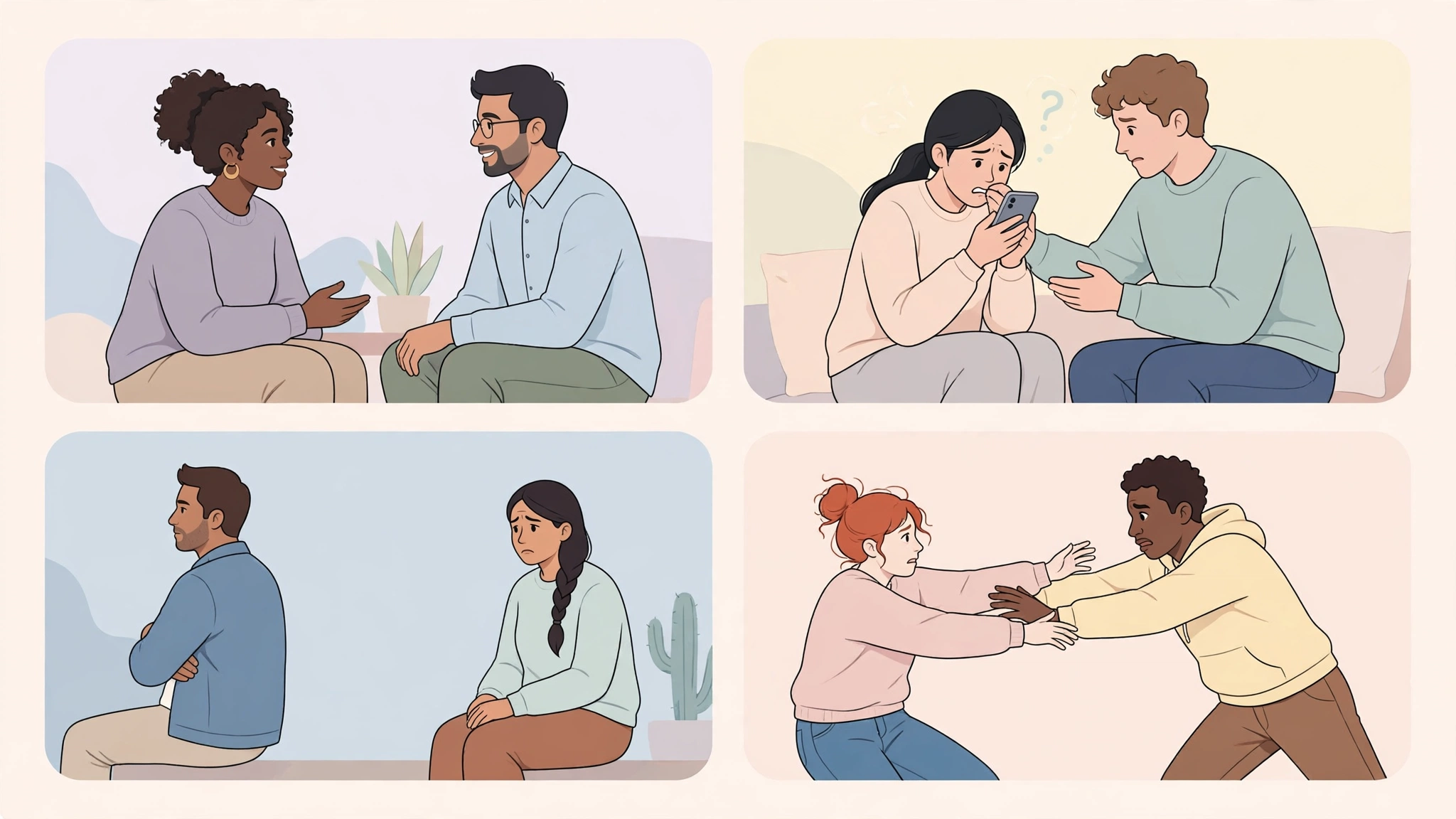
The Anxious-Avoidant Trap: One Argument, Played Out Step by Step
Attachment styles in relationships are easiest to see in motion, so let us watch the most studied pairing of all. It is Friday night. Daniel is stuck late at work and misses dinner. Maya, anxiously attached, texts at 7:40: “Are you coming?” No reply. Her attachment system fires — the delay is not a delay, it is evidence — so she sends two sharper messages by 8:15. Daniel, avoidantly attached, sees them at 8:40 and feels pressure. He reads criticism into the tone and goes quiet: self-protection to him, punishment to her. She escalates to a call, then “Fine, do whatever you want.” Now flooded, Daniel shuts down completely.
Both behaved exactly as their nervous systems trained them to: her brain flagged a loss of connection, his flagged emotional danger. The way out of clashing attachment styles in relationships is interruption, not victory. Either partner can break the loop by naming it: “We are doing our thing. I am anxious, you are overwhelmed, and neither of us is the enemy.” Then address the real needs underneath: she needs reassurance of connection, he needs a pause without punishment.
How Texting and Social Media Hijack Attachment Styles in Relationships
Almost no attachment guide talks about the phone in your pocket, yet texting is where modern attachment styles in relationships detonate. Read receipts turn a normal delay into a verdict. The anxious partner treats “seen at 9:12” as a character statement. The avoidant partner experiences constant accessibility as a demand, and their withdrawal looks cruel when it is timestamped.
Social media adds another trigger: the anxious partner scans likes and follows for threats, while the avoidant partner treats public emotional posts as pressure. Three rules defuse this. First, agree on response-time norms during calm moments, not fights: “I usually reply within a few hours, not minutes.” Second, give logistics before emotion: a quick “long day, call you at 9” prevents hours of spiraling.
Third, never resolve anything important by text; it strips away tone and lets both styles project their worst fears onto each other. And if you are texting from attachment panic after a breakup rather than in a relationship, read should you text your ex before your thumb decides for you.
Can Your Attachment Style Change? The Science of Earned Security
Change happens through repeated experiences of safety, not insight alone. Your nervous system learns from what keeps happening, so new patterns must be practiced. If you want professional guidance, the Gottman Institute’s guide on attachment style and relationship success is an excellent, research-backed starting point.
Here is the practice for each of the four attachment styles in relationships, style by style:
- If you lean anxious: Build a 10-minute self-soothing ritual for triggered moments (walk, breathe, journal) before you text. Ask for reassurance on a schedule, not in a crisis: “Can we do a quick check-in each evening?”
- If you lean fearful-avoidant: Work with a trauma-informed therapist; this style heals fastest with professional scaffolding. Meanwhile, practice letting good moments last without bracing for the ending.
- If you lean avoidant: Practice micro-vulnerability daily: name one real feeling to your partner before bed. Take timed breaks in conflict instead of disappearing, and always say when you will return.
- For every couple: Create one weekly repair ritual: five minutes of “what felt good, what felt shaky” trains your nervous system to expect reconnection after disconnection.
- Consider couples therapy: Emotionally Focused Therapy (EFT), developed by Dr. Sue Johnson, was designed specifically to reshape attachment bonds.

5 Myths About Attachment Styles in Relationships Worth Dropping
Myth 1: Your style is fixed for life. Early caregiving writes the first draft, but later relationships, therapy, and deliberate practice rewrite it. Earned security is well documented.
Myth 2: Anxious and avoidant partners can never work. They can. This pairing of attachment styles in relationships fails when both fight the person instead of the pattern; naming the loop turns it into a growth engine.
Myth 3: Avoidant people do not care. Research shows avoidant individuals have the same physiological stress responses as everyone else; they disconnect from the feeling, not from the caring. Understanding this changes everything about how you interpret their silence.
Myth 4: Secure people never feel anxious or need space. Secure attachment is not the absence of difficult emotions; it is feeling them without being hijacked, and asking for needs calmly.
Myth 5: You have one style everywhere. You can be secure with a friend, anxious with a partner, and avoidant with family. Your primary romantic style is simply the one that shows up most under pressure.
FAQs
What are the four attachment styles in relationships?
The four attachment styles in relationships are secure, anxious (preoccupied), avoidant (dismissive), and fearful-avoidant (disorganized). Secure people balance closeness and independence. Anxious people crave closeness and fear abandonment. Avoidant people protect independence and withdraw under emotional pressure. Fearful-avoidant people want closeness and fear it at the same time, creating push-pull dynamics.
Can my attachment style change over time?
Yes. Research suggests around 30 percent of adults shift attachment patterns during their lives. Psychologists call the journey toward security “earned secure attachment.” It grows through self-awareness, emotional regulation practice, consistently safe relationships, and often therapy. Change is gradual because your nervous system learns from repeated experience, not single insights.
Can I have more than one attachment style?
Absolutely. You might be secure with friends, anxious with a romantic partner, and avoidant with family. Even within one relationship, stress can activate a less secure pattern. Think of your style as a default setting rather than a permanent label. The goal is recognizing which pattern is running so you can choose your response.
Which attachment style is the healthiest?
Secure attachment is associated with the best outcomes: higher satisfaction, better conflict resolution, and greater resilience. But insecure styles are adaptive survival strategies, not character defects. The healthiest direction is not perfection; it is moving toward earned security by understanding your patterns and practicing new responses consistently over time.
What if my partner and I have different attachment styles?
This is extremely common, especially the anxious-avoidant pairing. Different styles are not a dealbreaker; the deciding factor is whether both partners commit to understanding the pattern instead of blaming each other. Learning each other’s triggers and using repair scripts turns style differences into a growth opportunity rather than a permanent war.
Do attachment styles affect friendships and parenting too?
Yes. Attachment patterns show up in every close bond, including friendships, family relationships, and parenting. An anxious friend may overthink unanswered messages; an avoidant parent may struggle with a child’s emotional outbursts. The same awareness and earned-security practices that heal romantic relationships improve every other connection in your life.
Your attachment style shaped how you love, but it does not get to decide how your story ends. Once you can see the pattern, you can change the pattern, and the couples who study their attachment styles in relationships and do the work consistently describe the same transformation: fewer explosions, faster repairs, and a quieter, steadier kind of love. Curious how compatible you and your partner really are? Try the free love calculator and the AI relationship assistant at relationshiptips.net for personalized insight into your dynamic.